
Legal Blog
Georgia Medical Board Addresses Questions Regarding APRN Protocol Agreements
The healthcare community has been closely watching developments involving the Georgia Composite Medical Board's interpretation of state laws governing Advanced Practice Registered Nurses (APRNs) who own or operate their own practices.
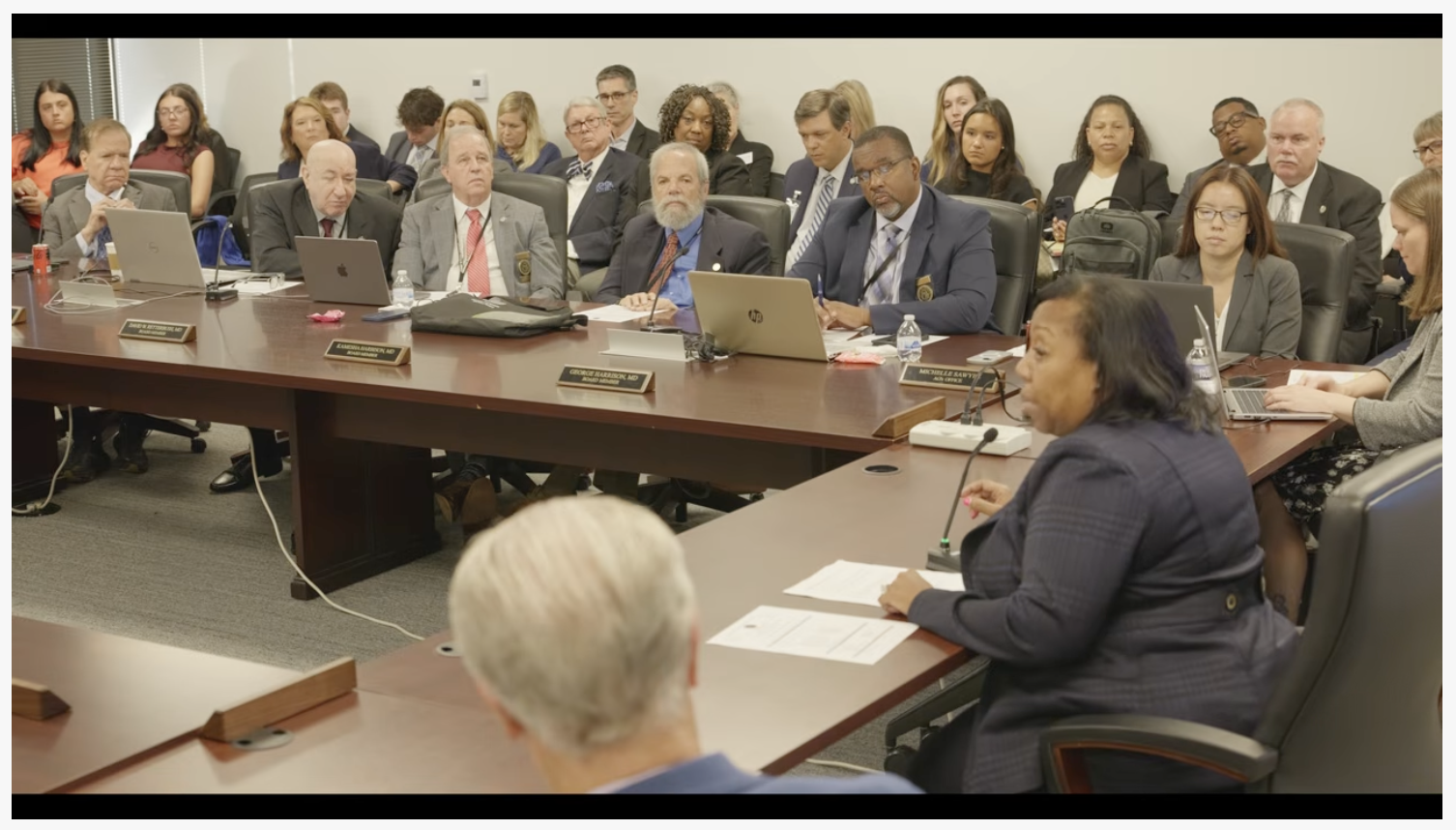
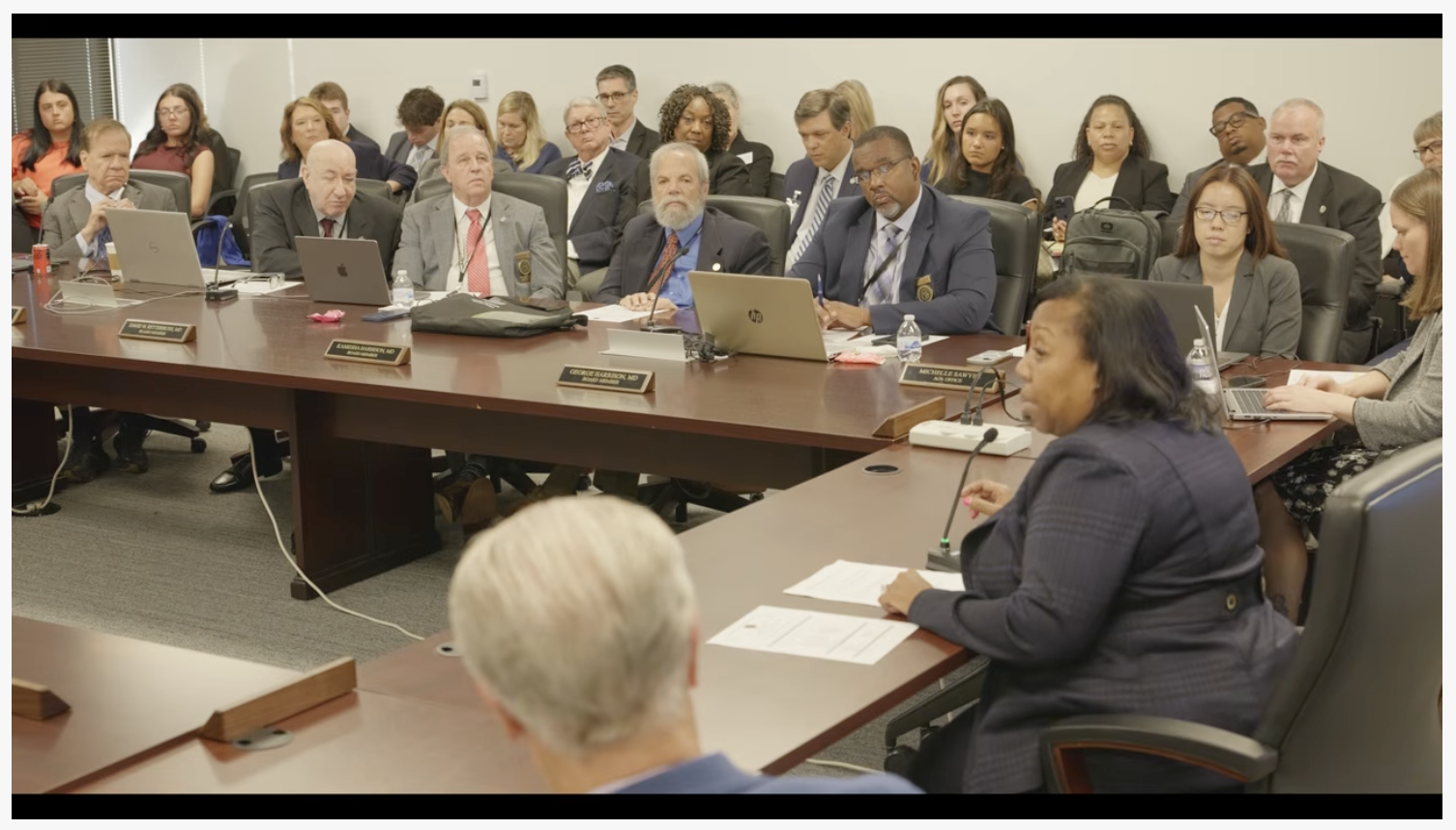
Former President of United Advanced Practice Registered Nurses of Georgia presenting a statement at June 4, 2026 meeting of the Georgia Composite Medical Board
The healthcare community has been closely watching developments involving the Georgia Composite Medical Board's interpretation of state laws governing Advanced Practice Registered Nurses (APRNs) who own or operate their own practices.
On May 9, 2026, the Medical Board issued a position statement addressing physician supervision and protocol requirements for APRNs and physician assistants. In it, the Board emphasized the legal requirement for APRN practices to have physician supervision. It went on to state that using a third-party service to connect APRNs with supervising physicians will not, by itself, resolve compliance concerns, and that Georgia law prohibits "a physician receiving compensation of any kind, monetary or non-monetary, from an APRN or an APRN-owned company in exchange for serving as the supervising or delegating physician." Because third-party physician matching companies and paid physician supervision arrangements are common in Georgia APRN-owned practices, many viewed the statement as a threat to their existing business models. The United Advanced Practice Registered Nurses of Georgia (UAPRN) posted that the Board’s statement posed “an immediate and serious risk to patient access to care across the state.” These concerns prompted many inquiries to the Board and even a protest organized by healthcare professionals at Liberty Square in downtown Atlanta, with the Board’s June 4th meeting being heavily attended by leaders in the medical community.
On June 5, 2026, the Medical Board released another statement and a follow-up document addressing what it described as "misinformation" surrounding these issues. The Board clarified that it is not requiring APRNs to close their practices or terminate existing protocol agreements. Instead, the Board maintains that its May statement only reflects its longstanding interpretation of Georgia law and was issued in response to an increasing number of questions and protocol applications that raised compliance concerns.
The Board’s clarification statement goes on to say that moving forward, it intends to closely examine physician-APRN relationships when reviewing protocol agreements to ensure independent medical judgment and a genuinely collaborative relationship between supervising physicians and advanced practice providers. Questions remain regarding how the Board’s interpretations will affect APRN practice structures, supervision arrangements, and future protocol approvals. The statement concludes with the Board acknowledging that discussions with stakeholders are ongoing and that additional guidance may be forthcoming as it works with the Georgia Boards of Nursing and Pharmacy to address these issues.
This article is provided for informational purposes only and does not constitute legal advice.

It’s About Time: The Georgia Legislature Relieves Barrier to Recovery for Nurses and Counselors Struggling with Addiction
Currently, nurses, social workers, and professional counselors with substance abuse issues in Georgia may face immediate public disciplinary action by their respective professional licensing boards, discouraging them from seeking help until a crisis occurs or a formal complaint is filed against them. House Bill 219 changes that landscape...

Currently, nurses, social workers, and professional counselors with substance abuse issues in Georgia may face immediate public disciplinary action by their respective professional licensing boards, discouraging them from seeking help until a crisis occurs or a formal complaint is filed against them.
Since 2010, the Georgia Professional Health Program (“GA PHP”) has confidentially assisted physicians, veterinarians, dentists, and pharmacists with evaluation and services for mental health and substance abuse disorders, including helping these professionals with hospital credentialing and malpractice carriers without notifying the licensing Board. However, to date, no parallel organization has existed to assist nurses or counselors. Given this reality, it has been difficult to counsel nurses and counselors to do the right thing and get treatment because doing so often resulted in immediate discipline.
House Bill 219 changes that landscape, as it creates an alternative program allowing licensees of the Georga Nursing Board and the Georgia Composite Board of Professional Counselors, Social Workers, and Marriage and Family Therapists suffering from substance abuse or mental health issues to voluntarily and confidentially disclose their illness and seek treatment, providing a pathway to recovery.
Driven in part by the nursing shortage in Georgia, HB 219 establishes a system in which nurses, counselors, and social workers can seek much-needed help while they continue to work. Additionally, advocates hope that much like the GA PHP assists physicians etc. facing potential discipline by their respective Boards for addiction-related complaints, these new professional health programs will help nurses and counselors navigate through what can be an otherwise frightening process. The complete text of HB 219 can be found here: https://www.legis.ga.gov/api/legislation/document/20252026/230918

The Georgia Tort Reform Act--Changes Made by SB68 and Their Effective Dates
On April 21, 2025, Governor Kemp signed the much-anticipated SB 68 and SB 69 into law as the Georgia Tort Reform Act. The new law codifying SB 68 contains 8 sections updating the rules of evidence, filing, discovery, and trials in personal injury cases in Georgia courts.
Signing Ceremony for the Georgia Tort Reform Act at the Georgia State Capitol / Image by the Office of the Governor
On April 21, 2025, Governor Kemp signed the much-anticipated SB 68 and SB 69 into law as the Georgia Tort Reform Act. The new law codifying SB 68 contains 8 sections updating the rules of evidence, filing, discovery, and trials in personal injury cases in Georgia courts. Most of the provisions of the new statute are retroactive. Sections 6 and 7 of the Act, however, are only applicable to causes of action arising on or after April 21, 2025.
The following sections apply retroactively and are therefore applicable to all currently pending tort cases:
Section 1 (Non-economic Damages - revision to OCGA §9-10-184). The Act’s first section limits how and when a party can argue for noneconomic damages before a jury. Noneconomic damages include claims for pain and suffering, loss of enjoyment of life, loss of consortium, etc. To address concerns about arbitrary dollar amounts being used to seek “nuclear” verdicts, this section requires that any evidence concerning noneconomic damages must be tied to actual evidence of a plaintiff’s pain and suffering.
Section 2 (Motion practice - revision to OCGA §9-11-12). This section makes several changes to civil filing procedures. When a defendant files a motion as its first pleading (e.g. a motion to dismiss or motion for more definite statement), the deadline for a defendant to file an answer is postponed until 15 days after the court rules on that motion. Discovery is also put on hold while any pre-answer motion is pending. However, if a defendant files an answer before the court rules on defendant’s motion, the stay on discovery shall immediately terminate.
Section 3 (Limits on Dismissals - revision to OCGA §9-11-41). A plaintiff is still permitted to unilaterally dismiss claims, but they must do so within 60 days of the defendant(s) filing an answer. If a plaintiff wants to dismiss a claim after that time, it must be with the consent of all parties in the lawsuit or upon an order of the court for terms it deems proper. A dismissal of this type will typically be considered “without prejudice,” meaning it is not a dismissal based on the merits of the claims.
Section 4 (Attorney’s Fees - revision to OCGA §9-15-16). A party can only recover attorney’s fees and costs of litigation once based on another party’s statutory violation, even if more than one statute entitles them to the recovery. Additionally, an agreement of a contingency fee is not allowed to be used as evidence when seeking attorney’s fees.
Section 8 (Bifurcation/Trifurcation - creating new code section OCGA §51-12-15). In tort cases, any party can now elect to have a trial split into phases: one phase determining fault, a second phase determining the amount of damages to be awarded to compensate a plaintiff for harm, and a third phase (if applicable) determining the amount of damages to be awarded to punish a defendant and/or allow a party to recover attorney’s fees and costs of litigation. This process is also known as bifurcation (a two-phase trial) or trifurcation (a three-phase trial), and all phases occur back-to-back with the same judge and jury. This new section also defines a couple exceptions that a party can raise to object to bifurcation/trifurcation.
The following sections of the Tort Reform Act only apply to causes of action arising on or after April 21, 2025, the day the Governor signed the Act into law:
Section 5 (Admissibility of Seatbelt Evidence - revision to OCGA §40-8-76). [Edited to add: An amendment to a related bill, SB69, states that the Admissibility of Seatbelt Evidence rule shall not apply retroactively but “only to actions commenced on or after the effective date of this Act” .] Evidence of whether a party was wearing a seatbelt can now be admitted in cases involving motor vehicle accidents. This change is long overdue and will inure to the benefit of many of our clients. Defendants in motor vehicle collisions will now be able to tell the jury that a plaintiff was not wearing a seatbelt and consequently, was injured more severely than if they had chosen to wear a seatbelt. However, seatbelt evidence cannot be used by insurance companies to cancel coverage or increase rates.
Section 6 (Negligent Security - creating new code sections OCGA §51-3-50 through §51-3-57). This statute contains an entirely new Article to regulate negligent security claims. The new law now provides the exclusive remedy in the majority, but not quite all, of the premises liability claims for negligent security where plaintiffs allege injuries caused by the wrongful act of a third party in cases filed against a premises owner, occupier, or security contractor. However, if the wrongful act was committed by an employee, or by another person “under the direction, control, or supervision” of an owner, occupier, or security contractor, then a plaintiff’s cause of action will still arise under pre-existing premises liability law.
Furthermore, under the old law, a duty was triggered when a third-party’s criminal actions were “reasonably foreseeable.” That is still the case, but the new statute narrows the definition to be more favorable to property owners and occupiers. This new section also details how to apportion fault, specifying that unless all third-party wrongdoers are more than 50% at fault, the court must set aside the verdict and order a retrial.
Section 7 (Medical Bills - creating new code section OCGA §51-12-1.1). In some tort actions, evidence of a plaintiff’s health insurance, including workers’ compensation benefits, may now be admissible at trial. This evidence will serve to determine the “reasonable value” of medically necessary treatment (i.e., a comparison of the amounts charged by a plaintiff’s medical providers and the amounts actually paid). This will allow our clients to reduce inflated awards for medical expenses, commonly known as “phantom damages.”
The Georgia Tort Reform Act is certain to have an immediate impact on personal injury cases generally, which will only increase as the changes to the negligent security paradigm and limitation on phantom damages begin to take effect as well. The plaintiffs’ Bar has already launched constitutional challenges to seatbelt admissibility and others are sure to follow. Georgia judges will certainly have their hands full as these cases start to percolate through our courts. For now, however, defendants can enjoy the more level playing field provided by the new Georgia Tort Reform Act.
You can read the full text of SB68 here.

Tort Reform on the Governor’s Desk in Georgia
Senate Bills 68 and 69, two of the largest pieces of tort reform legislation in nearly 20 years, have officially passed the state’s Senate Judiciary Committee in an 8-3 vote.
03/21/25 Update: SB68 has now passed in the House and Senate and is awaiting signature by the Governor.
Senate Bills 68 and 69, two of the largest pieces of tort reform legislation in nearly 20 years, have officially passed the state’s Senate Judiciary Committee in an 8-3 vote. On January 30th, Governor Brian Kemp announced the details of a comprehensive tort reform plan aimed at enhancing fairness in Georgia's legal system and stabilizing insurance costs for both businesses and consumers. According to the U.S. Chamber of Commerce’s Institute of Legal Reform, Georgia’s tort costs reached nearly $20 billion in 2022, which accounts for 2.60% of the state’s GDP. The proposed legislation will make several changes to tort litigation in an attempt to create a more balanced courtroom environment by making significant changes across various titles of the Official Code of Georgia Annotated, specifically Titles 9 (Civil Practice), 13 (Contracts), 40 (Motor Vehicles), and 51 (Torts).
Here are some of the key provisions contain in SB 68 and SB 69:
Limitations on Pain and Suffering Testimony: The bill seeks to establish constraints on testimony related to pain and suffering in civil cases, aiming to standardize and potentially reduce subjective assessments of non-economic damages.
Revisions to Civil Practice Procedures: SB 68 proposes adjustments to the timing of answers and discovery processes in civil litigation, intending to streamline procedures and enhance efficiency in the judicial system.
Provisions for Dismissal of Civil Actions: The bill outlines specific conditions under which civil actions may be dismissed, which could impact the duration and outcome of litigation.
Updates to Liability and Damages Calculations, Including Admissibility of Seatbelt Evidence: SB 68 aims to revise existing statutes concerning liability and the assessment of damages in tort cases, potentially affecting how fault and compensation are determined. One major change, which is long overdue, and which will inure to the benefit of many of our clients, will be allowing for evidence of whether a plaintiff was wearing a seatbelt in motor vehicle accident cases. This will put an end to the era where plaintiffs whose injuries were much more severe because they failed to wear their seatbelt can hide that fact from a jury.
The bill has received widespread support from the defense bar as well as local business associations. “This bill will protect both business owners and consumers from frivolous lawsuits, ensuring a more fair legal system,” stated the Georgia Restaurant Association in a LinkedIn post after the Governor’s announcement. “We look forward to collaborating with the governor to advance this critical legislation!” Critics of the bill express concerns for plaintiffs’ rights and skepticism that the reform will create any economic benefit for the average Georgian.
Sources:
1 Governor Kemp Unveils Plan to Tackle Tort Reform and Stabilize Insurance Costs for Hardworking Georgians: https://gov.georgia.gov/press-releases/2025-01-30/gov-kemp-unveils-plan-tackle-tort-reform-and-stabilize-insurance-costs
2 The Growing Burden of Tort Costs on Georgia Households: A Call for Reform: https://instituteforlegalreform.com/blog/the-growing-burden-of-tort-costs-on-georgia-households-a-call-for-reform/
3 The full text of the legislation can be found at: https://www.legis.ga.gov/legislation/69756.
Georgia Court of Appeals Overturns Massive $54M Verdict Against Avis for Crash Following Employee’s Theft of Vehicle
In a recent pair of companion cases, Avis Rent A Car System v. Johnson, 352 Ga.App. 858 (2019) and Avis Rent A Car System v. Smith, 353 Ga.App. 24 (2019), the Georgia Court of Appeals reversed massive jury verdicts totaling $54M on the grounds that an Avis employee’s theft of a rental vehicle cut off Avis’s liability for the employee’s subsequent crash that injured the bystander plaintiffs.
In a recent pair of companion cases, Avis Rent A Car System v. Johnson, 352 Ga.App. 858 (2019) and Avis Rent A Car System v. Smith, 353 Ga.App. 24 (2019), the Georgia Court of Appeals reversed massive jury verdicts totaling $54M on the grounds that an Avis employee’s theft of a rental vehicle cut off Avis’s liability for the employee’s subsequent crash that injured the bystander plaintiffs.
The two plaintiffs’ respective cases arose from the same incident where an Avis employee stole a rental SUV after hours from a downtown Atlanta branch and then later fled from the police before crashing into a brick wall where both plaintiffs were sitting. The plaintiffs suffered significant injuries and filed suit against Avis, a regional security manager, the operator of the Avis location, the operator’s owner, and the operator’s employee who stole the vehicle.
At the trial court level, the juries found that Avis was vicariously liable for the employee’s negligence in causing the crash and, in the Smith case, found that Avis was also vicariously liable for the fault that was apportioned to the operator and its owner. Avis filed a motion for a judgment notwithstanding the verdict or, in the alternative, for a new trial; the trial court denied the motions.
Avis appealed the holdings and last year the Georgia Court of Appeals reversed the verdicts and held that only the car thief employee could be held liable for the plaintiffs’ injuries. In both appeals cases, the Court of Appeals held that the at-fault employee’s criminal acts – namely, his after hours theft of the vehicle and high-speed flight from the police some five hours later – were intervening acts that severed Avis’s liability for the incident. The Court further recognized Georgia’s long line of appellate decisions holding that a car thief’s criminal acts were the sole proximate cause of plaintiffs’ injuries in those cases
Further, in the Smith case, the Court found that Avis, the operator, and its owner could not be liable for negligent hiring and retention of the car thief employee because the employee was not acting under the color of his employment when the theft and subsequent accident occurred.
However, the two cases did not end at the Court of Appeals, as the Georgia Supreme Court granted certiorari and heard oral argument last December. The Supreme Court’s pending holding could very well dramatically alter the landscape of vicarious liability law in Georgia, so we encourage you to keep an eye on this space for further analysis once the Supreme Court issues its ruling.
Georgia Passes Law to Shield Businesses from COVID-19 Liability
The Georgia legislature recently passed a bill designed to shield healthcare facilities and other business entities from civil liability related to the spread of COVID-19. On August 5, 2020, Governor Brian Kemp signed the “Georgia COVID-19 Pandemic Business Safety Act,” which provides businesses with a general shield against civil tort lawsuits brought by members of the public, customers, or employees who alleged that they contracted or were exposed to the virus while on the premises.
The Georgia legislature recently passed a bill designed to shield healthcare facilities and other business entities from civil liability related to the spread of COVID-19. On August 5, 2020, Governor Brian Kemp signed the “Georgia COVID-19 Pandemic Business Safety Act,” which provides businesses with a general shield against civil tort lawsuits brought by members of the public, customers, or employees who alleged that they contracted or were exposed to the virus while on the premises.
Although the text of the Act is focused on healthcare providers, it applies to any “healthcare facility, healthcare provider, entity, or individual,” which, consequently, encompasses almost any business in Georgia. The Act shields businesses from COVID-19-related lawsuits except in cases where a business acted with “gross negligence, willful and wanton misconduct, reckless infliction of harm, or intentional infliction of harm.”
Additionally, businesses that provide a written warning are further protected by a rebuttable presumption that the person bringing the lawsuit assumed the risk of contracting COVID-19 by entering the business. To qualify for this additional protection under the Act, businesses must post the statutorily-prescribed warning either (1) on a sign at the business premises’ point of entry, or (2) on a receipt or as part of a proof of purchase for entry. Notably, these presumptions and written warning requirements are in addition to, and do not limit, the overall legal immunities created under the Act.
It is important to note that while the Act provides a defense against virus-related tort claims, it does not preclude claimants from bringing claims or filing lawsuits against Georgia businesses – meaning businesses will still incur the costs of defending these actions even if the Act ultimately shields them from liability. Further, the Act only protects Georgia businesses for claims arising from exposures to COVID-19 that occur up through July 14, 2021.
As Georgia business owners certainly know, the COVID-19 pandemic has created a complicated environment filled with uncertainty. While the Act provides businesses with a layer of protection for virus-related claims, owners and managers are encouraged to coordinate their reopening plans with legal counsel to ensure that they are optimally protected.
Georgia Supreme Court Expands Potential Unlimited Punitive Damages in Civil Cases Involving an Intoxicated Defendant
In Reid v. Morris, Case No. S20A0107 (Ga. S. Ct., June 29, 2020), the Supreme Court of Georgia held that under Georgia’ s punitive damages statute, a defendant may be subject to unlimited punitive damages if he commits a tort while intoxicated—even if the tort does not involve driving under the influence. In this case, the two defendants, Stroud and Morris, were drinking together, and though Stroud knew Morris was drunk, had no license, and was known to be reckless, he gave Morris his car keys and let him drive. The plaintiff was injured when his vehicle was struck by the vehicle driven by Morris.
In Reid v. Morris, Case No. S20A0107 (Ga. S. Ct., June 29, 2020), the Supreme Court of Georgia held that under Georgia’ s punitive damages statute, a defendant may be subject to unlimited punitive damages if he commits a tort while intoxicated—even if the tort does not involve driving under the influence. In this case, the two defendants, Stroud and Morris, were drinking together, and though Stroud knew Morris was drunk, had no license, and was known to be reckless, he gave Morris his car keys and let him drive. The plaintiff was injured when his vehicle was struck by the vehicle driven by Morris.
The plaintiff sued both Morris and Stroud. He alleged that Stroud negligently entrusted the vehicle to Morris, and he sought punitive damages against both defendants. The trial court ruled that under O.C.G.A. § 51-12-5.1(f), only an “active tortfeasor” could be liable for punitive damages, which would only be the impaired driver. The Georgia Supreme Court vacated this part of the trial court’s judgment and remanded the case to determine whether Stroud was an “active tortfeasor” and thereby subject to punitive damages.
Construing O.C.G.A. § 51-12-5.1(f), the Court held that an “’active tort-feasor,’ as used in the statute, is not necessarily limited to drunk drivers.” Instead, the statute imposes unlimited punitive damages when “the defendant was intoxicated to the degree that his judgment was substantially impaired” and his “positive acts of negligence” were the proximate cause of the plaintiff’s injury.
Now, after Reid v. Morris, Defendants and liability insurers must consider the potential for unlimited punitive damages in all cases in which alcohol or drugs are involved, not just those involving DUI drivers. For example, if a homeowner has a few too many drinks before deciding to pressure wash the sidewalk in front of his house on a sub-freezing day, a resulting slip and fall accident with minor injuries could subject the homeowner to unlimited punitive damages under O.C.G.A. § 51-12-5.1(f). Thus, defendants and their counsel should anticipate that plaintiffs’ attorneys will now seek to develop evidence of possible intoxication in most every case.
Georgia Supreme Court Recognizes Alternative Licensing Certification for Lactation Care Providers
In a recent decision, the Georgia Supreme Court held that the State Constitution protects Georgians’ right to pursue an occupation of their choosing free from unreasonable government interference. The case directly concerned the rights of lactation care providers (LCs) to practice with alternative licensing credentials, though it could potentially have a far-reaching impact on other professionally licensed occupations in Georgia.
In a recent decision, the Georgia Supreme Court held that the State Constitution protects Georgians’ right to pursue an occupation of their choosing free from unreasonable government interference. The case directly concerned the rights of lactation care providers (LCs) to practice with alternative licensing credentials, though it could potentially have a far-reaching impact on other professionally licensed occupations in Georgia.
In Jackson, et al. v. Raffensperger, Plaintiffs Mary Jackson and her non-profit lactation consulting organization, Reaching Our Sisters Everywhere, Inc. (“ROSE”) filed a lawsuit against the Secretary of State challenging the constitutionality of the Georgia Lactation Consultant Practice Act (the “Act”), which prohibits the practice of “lactation care and services” for compensation without a license from the Secretary of State. Plaintiffs alleged that under the Act, they were not eligible for a license because they lacked a privately issued credential that the Act requires for licensure, even though they had other private credentials that made them equally competent to provide lactation care and services to the public. Plaintiffs argued that the Act violated their constitutional rights.
On Appeal, the Georgia Supreme Court recognized that LCs – like other practitioners in the healthcare field – can obtain certification from multiple private accrediting entities. Here, the Court found that the two most prominent certifications are Certified Lactation Counselor (“CLC”), which Jackson and many members of ROSE had, and International Board-Certified Lactation Consultant (“IBCLC”). While there were significant differences in the credentialing requirements between CLC and IBCLC, the Court recognized that CLCs and IBCLCs are equally competent to provide lactation care and services to mothers and babies and there was no evidence that CLCs or other unlicensed LCs have ever harmed public health, safety, or welfare. Nonetheless, the Act only permitted IBCLCs to be licensed by the State. The Court noted that discrepancy and found it to be an unreasonable government interference on LCs to pursue their occupation.
Continuing its analysis, the Court found held that the Georgia Constitution affirmatively protects an individual’s right to pursue the lawful occupation of her choosing free from unreasonable government interference.
While this case exclusively concerned lactation care providers, Georgia’s licensed healthcare and other professionals should be aware that the Court’s holding could potentially be used to challenge the State’s licensing protocols in other professions. Provided that practitioners can show that the alternative licensing entity is as meritorious and safe as State-approved licensing entity, those practitioners may also have a path to valid licensure by the State.
Georgia’s Professional Licensing Boards Approve Temporary Practice Permits for Healthcare Providers in Response to COVID-19 Pandemic
In response to the public health emergency posed by the novel coronavirus, some of Georgia’s licensing boards have been authorized to issue “emergency practice permits” allowing healthcare professionals from other states to practice in Georgia for a limited amount of time. Interested healthcare professionals are encouraged to review the following information and to contact their respective licensing boards as indicated below.
In response to the public health emergency posed by the novel coronavirus, several of Georgia’s licensing boards have been authorized to issue “emergency practice permits” allowing healthcare professionals to practice in Georgia for a limited amount of time. Interested healthcare professionals are encouraged to review the following information and to contact their respective licensing boards as indicated below. Our team of lawyers at Levy Pruett Cullen is working remotely and monitoring the rapidly evolving pandemic. Please check our website for updates and call with any questions: 404-371-8857.
Georgia Composite Medical Board
Following the Governor’s March 14th declaration of a public health emergency, the Georgia Composite Medical Board may approve and issue “emergency practice permits” to physicians, physician assistants, advanced practice registered nurses, and respiratory care professionals who wish to practice medicine in Georgia during the current COVID-19crisis.
Before practicing medicine in Georgia pursuant to an emergency practice permit, the applicant must receive the Board’s approval of the following:
An application for an emergency practice permit (see link below).
Proof of current and unrestricted licensure in another state.
Copy of a valid government-issued photo ID, and
A current National Practitioner’s Data Bank Report.
All permits issued under this provision shall be valid for 90 days or until the state of emergency has been lifted by Georgia’s governor, whichever comes first.
Information for submitting an application, as well as the permit application itself, is available at https://medicalboard.georgia.gov/press-releases/2020-03-16/gcmb-emergency-practice-permittemp-license-response-covid-19.
Georgia Board of Nursing
Following the Governor’s March 14th declaration of a public health emergency, the Georgia Board of Nursing is authorized to issue temporary permits to licensed practical nurses, registered nurses, and advanced practice registered nurses who have an active, unencumbered license in any other U.S. jurisdiction who are coming to Georgia to respond to the COVID-19 pandemic.
Temporary permits issued by the Georgia Board of Nursing are valid for 30 days, though the Board is authorized to extend the expiration date. This policy is effective while a State of Emergency, as declared by the Governor, exists in any Georgia county or until rescinded by the Board, whichever occurs first. Application fees for the temporary permit are waived for those applying to practice in response to the COVID-19 emergency.
Additional information and the permit application are available at https://sos.ga.gov/index.php/licensing/plb/45/emergency_temporary_permits.
Finally, Georgia is a member of the Nurse Licensure Compact, which allows licensed practical nurses and registered nurses with a multi-state license from another Compact jurisdiction to practice in Georgia.
Georgia Board of Pharmacy
Following the Governor’s March 14th declaration of a public health emergency, the Georgia Board of Pharmacy is authorized to issue temporary licenses to dispense prescription drugs for pharmacists who are not licensed in Georgia but are currently licensed in another state. A temporary license may be issued if (1) the Board can verify the applicant’s current licensure is in good standing with the state or indirectly via a third-party verification system and (2) the applicant is engaged in a documented COVID-19 relief effort.
The Board is also authorized to issue temporary licenses for pharmacy technicians and pharmacy interns to assist pharmacists in dispensing prescription drugs in response to the COVID-19 emergency. Pharmacy technicians and pharmacy interns applying must also be currently registered or licensed in good standing in another state.
The temporary recognition of non-resident pharmacist licensure and pharmacy intern licensure shall remain valid until the end of the month following the third board meeting conducted after the license is issued and shall not be renewed. The temporary recognition of non-resident pharmacy technician registration shall cease when the state of emergency is lifted.
Additional information from the Georgia Board of Pharmacy and permit applications are available at https://gbp.georgia.gov/press-releases/2020-03-17/covid-19-coronavirus-response-georgia-board-pharmacy.
Summary Judgment in Rainy Day Slip and Falls May be a Thing of The Past
Plaintiff testified that she slipped on “standing water,” but could not describe the depth, width, or quantity of water.
Property owners and their insureds take note: a Court of Appeals’ decision will make it much more difficult for property owners to get summary judgment in cases where plaintiffs slip in rain tracked into a building.
In Duff v. Bd. Of Regents of the Univ. Sys. Of Georgia, (hereafter, the “Trial Court Order”), the Plaintiff, a student at Georgia Perimeter College (“GPC”), exited a classroom and slipped and fell on rainwater tracked in by hundreds of students entering the building. It was undisputed that it had not been raining when Plaintiff first entered the building or that she had seen any rain on the floor on her way to class.
the Plaintiff testified that she slipped on “standing water,” but could not describe the depth, width, or quantity of water. She also testified that her clothing was wet when she got up. A professor who assisted her after the fall testified that Plaintiff fell on a very thin layer of water analogous to the amount of water left after you take “a wet paper towel and wiped it across a surface.” The professor also testified that at the time she fell, students were standing outside of the classroom waiting to get in wearing wet clothes and carrying dripping umbrellas.
The trial court granted GPC’s motion for summary judgment, relying on Georgia precedent that rainwater is not in and of itself a hazardous condition unless plaintiff can demonstrate that there is an “unreasonable accumulation of water.” Relying on a 2013 Court of Appeals’ case (Season All Flower Shop, Inc. v. Rorie, 323 Ga. App. 529), the trial court also held that summary judgment was appropriate even though the Plaintiff fell in an interior hallway as opposed to an entrance. Specifically, quoting the Appeals Court in Season All Flower, the trial court held that “‘water is apt to be found in any area frequented by people coming in from the rain outside, and not just at the ‘threshold’ of an entrance door.’”
In a decision that must not be taken lightly by property owners and their insureds, the Court of Appeals reversed. The Court held that Plaintiff’s self-serving testimony regarding “standing water” (despite her inability to describe the dimensions of that water) created a question of fact and precluded summary judgment. Relying on Dickerson v. Guest Svcs. Co., 282 Ga. 771 (2007), the Court of Appeals wrote that although it is “common knowledge that the ground outside gets wet on rainy days, it cannot properly be applied to a portion of an interior space where [people] have no reason to expect water to accumulate on the floor.”
Our insured property owners and managers must take note of the Court of Appeals’ decision in Duff, as it appears to create a duty to continuously monitor during rain, particularly in buildings with heavy foot traffic. As the trial court warned, “[a] departure from the rainy day case law here [could] result in premises owners having to ‘continuously mop during a shower’ each time it rains simply because it is possible that one [person] does not know it is raining outside. This result would essentially eviscerate the protections that are afforded to premises owners on rainy days.”
At the very least, the Court of Appeals’ decision will make it much more difficult for property owners to get summary judgment in cases where plaintiffs slip in rain tracked into a building, regardless of whether management places mats at the entrance. It all comes down to location. Business owners may feel pretty confident in his/her chances of getting out on a motion for summary judgment when a plaintiff’s slip and fall occurs at the entrance of the premises on a rainy day. However, after Duff, plaintiffs will have an easier time creating a question of fact when they slip and fall on rain tracked into the interior of the building, which would preclude summary judgment.